
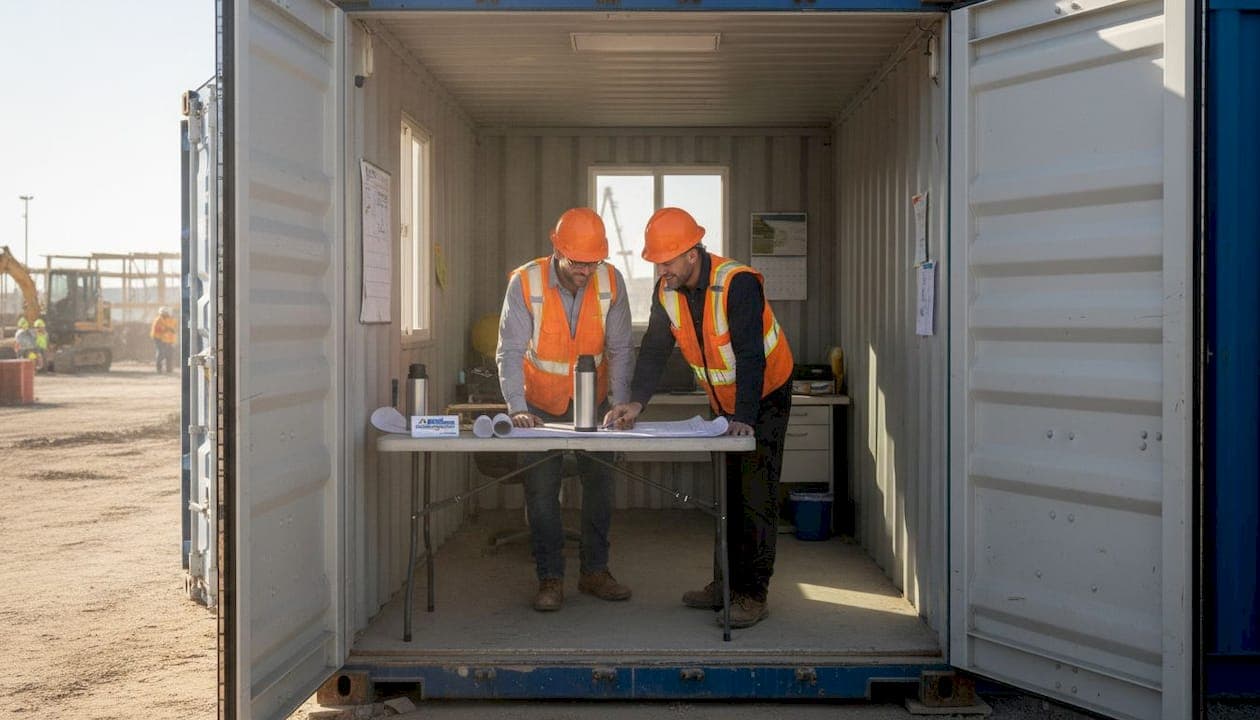
When you're managing a construction project or running a field operation, finding office space fast is a real problem. Traditional builds take months and cost a fortune. Shipping container offices solve both issues. They deliver finished space in weeks at a fraction of conventional construction costs, making them a practical choice for business owners and project managers who need functional, professional workspace without the long wait or budget overruns. This guide covers cost savings, customization options, site requirements, and the scenarios where container offices truly make sense.
Table of Contents
- Cost savings and speed of deployment
- Customization and flexibility for modern workspaces
- Practical site considerations and compliance
- Limitations and best-use scenarios
- What most guides miss about container office conversions
- Get started with your own shipping container office
- Frequently asked questions
Key Takeaways
| Point | Details |
|---|---|
| Save money and time | Container offices provide rapid, affordable workspace compared to traditional builds. |
| Adaptable solutions | Custom containers can be configured and expanded to fit almost any business need. |
| Handle permitting early | Regulatory planning prevents costly delays in deployment. |
| Best for flexible projects | Container offices excel in temporary or fast-changing environments. |
Cost savings and speed of deployment
Time is money on any project site. When your team needs a place to review plans, hold meetings, or manage logistics, waiting six months for a traditional office build is not an option. Shipping container offices change that equation significantly.
The numbers tell a clear story. Container office costs typically run $100 to $185 per square foot, compared to $250 to $500 or more for conventional construction. That gap can represent tens of thousands of dollars saved on a single project. Conversion timelines run roughly 2 to 8 weeks, while traditional builds often take six months or longer.
| Factor | Container office | Traditional build |
|---|---|---|
| Cost per sq ft | $100–$185 | $250–$500+ |
| Time to occupancy | 2–8 weeks | 4–12 months |
| Relocatability | Yes | No |
| Scalability | Modular | Fixed |
For time-sensitive projects, that speed advantage is decisive. Consider a contractor who wins a bid and needs site management space within the month. A container office can be ordered, modified, and delivered while the project is still in its early mobilization phase. No delays, no temporary trailer rentals that eat into margins month after month.
Key cost advantages include:
- Lower material and labor costs compared to stick-built construction
- No foundation work required in most temporary setups
- Reusable across multiple projects, spreading the investment over time
- Faster return to productivity for your team
These business uses for shipping containers extend well beyond simple storage, and the financial case for office use is one of the strongest arguments in the category.
Pro Tip: Schedule your delivery date and interior fit-out work simultaneously. Coordinating electrical, insulation, and furniture installation before the container arrives can cut your setup time by a full week or more.
Customization and flexibility for modern workspaces
One of the biggest misconceptions about container offices is that they look industrial and bare. In practice, they can be outfitted to match nearly any functional requirement your team has.
Modern container office builds support a wide range of interior and exterior options. You can add partition walls to create private offices or meeting rooms, install HVAC systems for climate control, run full electrical with outlets and lighting, and cut openings for standard or oversized windows and doors. Exterior finishes can include paint, cladding, or branding wraps.
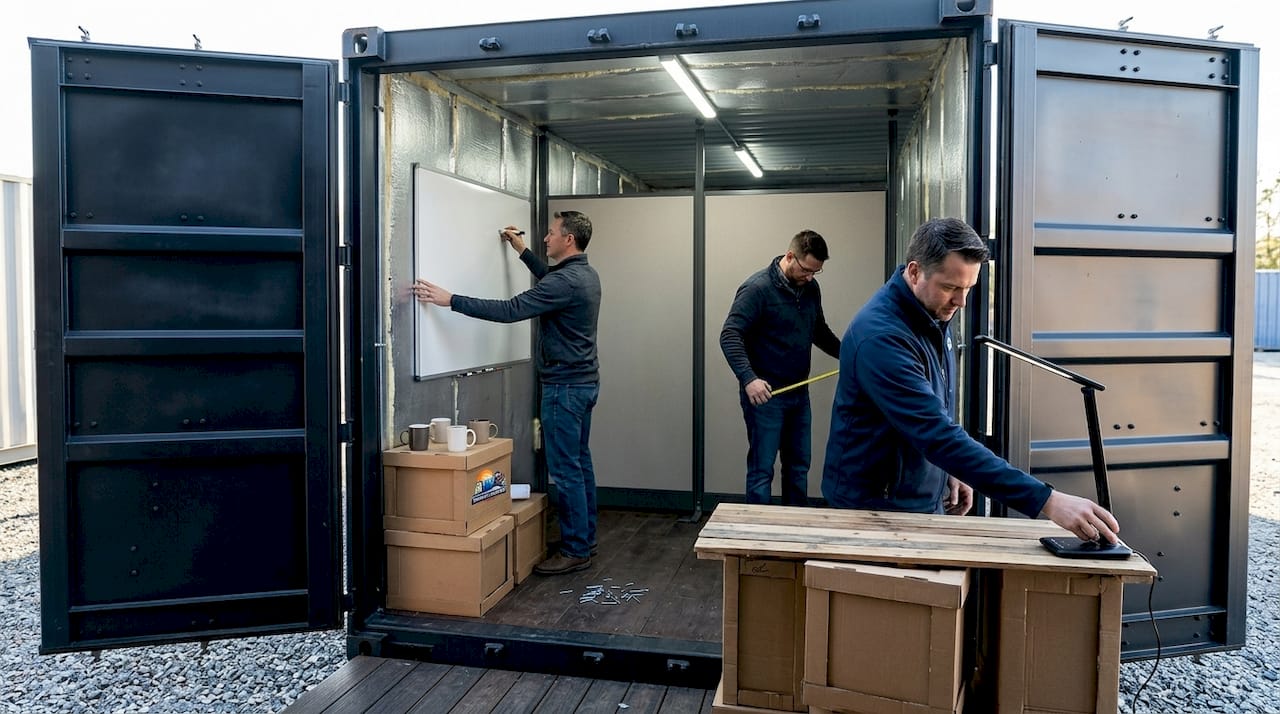
Flexible workplace examples from real projects show that container offices support phased scaling, custom fit-outs, and modular expansion without major structural rework. That means you can start with one 20ft unit and add a second later when your team grows.
| Customization option | Available | Notes |
|---|---|---|
| HVAC systems | Yes | Mini-split or ducted |
| Partition walls | Yes | Open or private layout |
| Electrical and lighting | Yes | Panel, outlets, LED |
| Windows and doors | Yes | Standard or custom sizes |
| Exterior cladding | Yes | Paint, metal, or wrap |
Common configurations include:
- Single unit offices for small project teams or site supervisors
- Double-wide setups using two containers side by side
- Stacked configurations for two-story office space on tight footprints
- Connected clusters for larger operations needing multiple rooms
For construction sites, remote operations, or businesses that move between locations, this flexibility is a major advantage. You can explore container office workshop options to see how these builds translate into functional, ready-to-use spaces.
The container solutions for business available today go far beyond basic modifications. Insulated walls, vapor barriers, and proper ventilation make these units comfortable in both hot and cold climates.
Pro Tip: If your project has both a temporary phase and a longer-term need, plan your container office for the temporary phase first. You can relocate it, reconfigure it, or sell it when the project ends rather than writing off a fixed construction investment.
Practical site considerations and compliance
Before you order a container office, the site work matters just as much as the unit itself. Skipping this step is where most project delays actually come from.
Here is a practical sequence to follow:
- Check local permit requirements. Permitting and code compliance vary significantly by jurisdiction and depend on whether the office is classified as temporary or permanent. Contact your local building department early.
- Assess site access. Delivery trucks need adequate clearance. Measure your entry points and confirm the delivery vehicle can reach the placement location.
- Prepare the ground. Most container offices require a level surface. Gravel pads, concrete piers, or a poured slab are common options depending on permanence and load requirements.
- Plan utility connections. Electrical hookup is the most common need. Water and sewer connections add complexity and cost, so factor those in if your office needs restroom facilities.
- Address thermal and moisture control. Proper insulation and vapor barriers are not optional. Without them, condensation builds up inside the container and causes long-term damage to both the structure and your equipment.
- Document everything. Keep inspection reports, permits, and modification records on file. This protects you during project audits and simplifies future relocations.
"Regulatory permitting and code compliance vary by location and must be planned early to avoid costly project delays."
Review the shipping container modifications guide before finalizing your build specs. Understanding what modifications require structural reinforcement will help you avoid surprises during installation.
The site prep investment is usually modest, but ignoring it creates problems that cost far more to fix after the fact. A gravel pad and a licensed electrician for the hookup are standard starting points for most temporary setups.
Limitations and best-use scenarios
Container offices are not the right answer for every situation. Knowing where they work best helps you make a smarter decision before committing.
They perform best in these scenarios:
- Construction site management offices where the team needs to be on location
- Temporary project headquarters for contracts lasting 6 to 36 months
- Remote or rural worksites where conventional construction is impractical
- Popup or seasonal business offices that need to move with demand
- Rapid-response deployments where speed of setup is the top priority
However, the picture changes for larger or more complex builds.
"The cost advantage of container offices can narrow or reverse for multi-unit or highly finished container complexes."
When you start comparing containers to metal buildings, the economics shift at scale. Joining multiple containers requires structural cutting and reinforcement. High-end interior finishes, custom HVAC zoning, and complex MEP (mechanical, electrical, plumbing) systems add costs that close the gap with conventional construction quickly.
If you need a permanent, large-footprint office with executive-level finishes, a traditional build or a purpose-built modular office may serve you better. For smaller footprints and faster timelines, containers win. You can also look at portable office alternatives if your square footage needs are minimal and speed is the only priority.
The honest answer is that container offices are a tool, not a universal solution. Match the tool to the job.
What most guides miss about container office conversions
Most articles focus on the upside and gloss over the technical realities that determine whether a container office project succeeds or struggles.
The biggest overlooked cost is systems, not finishes. Business owners often budget for flooring, paint, and furniture, then get surprised by the cost of proper insulation, HVAC installation, and electrical panel work. Insulation and condensation control are essential for livability and avoiding long-term deterioration of the structure. These are not optional line items.
Cutting openings in a container for windows, doors, or utility penetrations also requires structural reinforcement. Steel framing around every cut is standard practice. Skipping it compromises the container's load-bearing integrity. This work demands experienced fabricators, not general contractors unfamiliar with steel construction.
The best return on investment comes from simple, fast, flexible builds. A 20ft container with insulation, electrical, two windows, and a standard door can be ready in three weeks and serve a team of four comfortably. That is where container offices genuinely outperform alternatives. The further you push toward high-end, permanent, or complex multi-unit builds, the more that advantage erodes. Review the container conversions guide to set realistic expectations before you finalize your specs.
Get started with your own shipping container office
If a shipping container office fits your project timeline and budget, the next step is straightforward. A M Shipping Containers offers a range of units suitable for office conversion, backed by 47-point inspection reports and transparent, all-inclusive pricing. No hidden fees, no surprises on delivery day.
You can browse container office inventory to find the right size and condition for your needs. The team also supports custom modifications including insulation, electrical work, windows, and doors. Explore the full range of container solutions or visit amshippingcontainers.com to request a quote and get nationwide delivery to your project site.
Frequently asked questions
How long does it take to set up a shipping container office?
Setup typically takes 2 to 8 weeks depending on the level of customization and local permitting requirements. Simple builds with minimal modifications are on the faster end of that range.
Are container offices good for year-round use?
Yes. With proper insulation, HVAC, and moisture control measures, container offices can maintain comfortable working conditions in both hot summers and cold winters.
What permits do I need for a shipping container office?
Permit requirements vary by city, county, and state, and depend on whether the office is classified as temporary or permanent. Check with your local building department before placing an order.
Can container offices be relocated after installation?
Yes. Container offices are built for mobility. Modular expansion and relocation are core advantages, and most units can be moved to a new project site with standard crane or forklift equipment.
Is a shipping container office cheaper than modular office trailers?
For small or short-term setups, containers are often more cost-effective. However, the cost advantage narrows for larger, highly customized configurations where multi-unit joining and premium finishes are involved.