
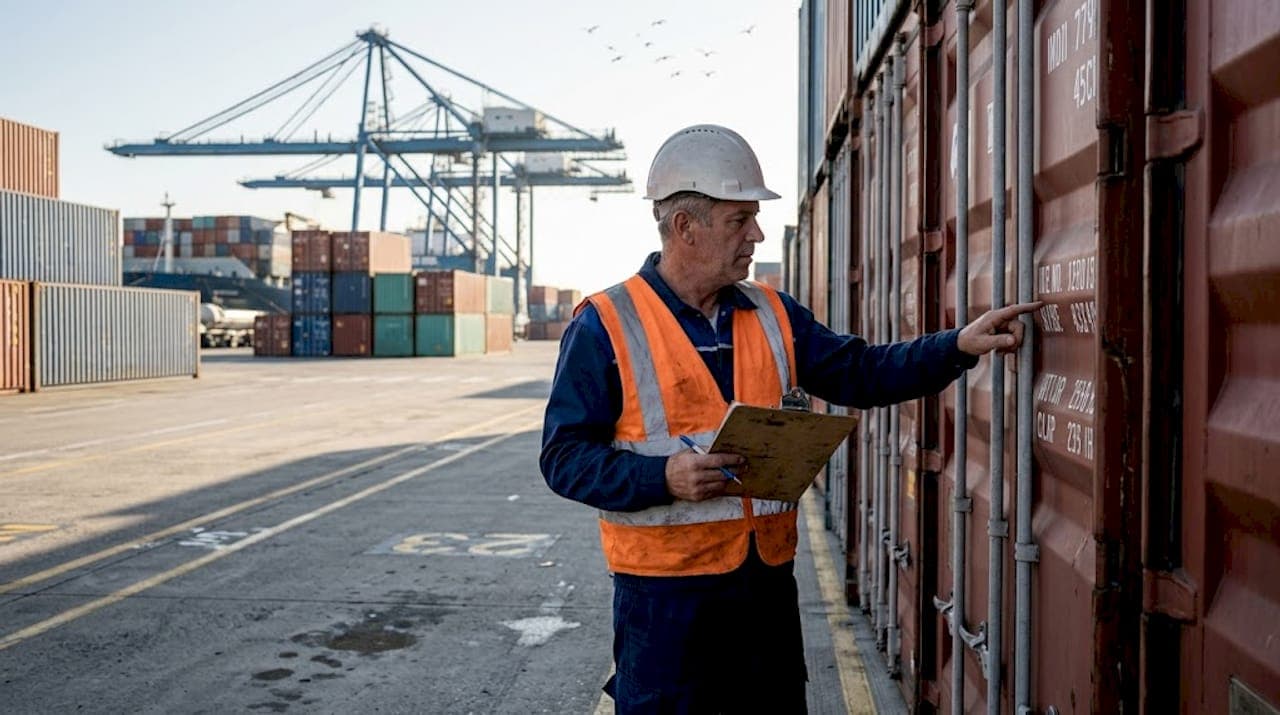
Nearly 1,582 containers are lost at sea every year, and a significant share of those losses trace back to preventable compliance failures. For construction and logistics managers, that number is not just a maritime statistic. It represents project delays, insurance claims, cargo damage, and regulatory scrutiny. Shipping containers are not interchangeable steel boxes. They are engineered systems governed by precise international and U.S. standards that dictate how they are built, marked, tested, and used. This guide breaks down the standards that matter most, explains what compliance actually requires, and gives you practical steps to keep your operations safe and efficient.
Table of Contents
- What are the main industry standards for shipping containers?
- Key technical requirements: Dimensions, ratings, and coding explained
- Testing and inspection: Ensuring compliance and ongoing safety
- Common compliance pitfalls and how to avoid them
- Industry insights: Why standard compliance still gets overlooked
- Get compliant, high-quality containers for your operation
- Frequently asked questions
Key Takeaways
| Point | Details |
|---|---|
| Mandatory ISO standards | Shipping containers must meet ISO 668, ISO 6346, and related series for dimensions, markings, and construction. |
| Regular testing required | Ongoing inspections, especially for CSC compliance, are necessary to keep containers legally operational. |
| Avoid compliance shortcuts | Most costly accidents result from skipping inspections or using non-compliant containers, not from unusual events. |
| USCG has enforcement authority | In the U.S., the Coast Guard enforces regulations and can penalize non-compliant operations. |
| Compliance offers business advantages | Meeting industry standards boosts safety, efficiency, insurance eligibility, and customer confidence. |
What are the main industry standards for shipping containers?
Understanding which standards apply is the first step toward building a compliant operation. The key standards include ISO 668, ISO 6346, ISO 1496, ISO 1161, and the CSC, each covering a different aspect of container design and use. Together, they form the backbone of global intermodal freight safety.
Here is a quick breakdown of what each standard covers:
- ISO 668: Defines the base external dimensions and maximum gross weight for standard containers
- ISO 1496 series: Sets construction requirements and testing procedures for structural integrity
- ISO 6346: Governs container identification, marking codes, and data systems
- ISO 1161: Specifies corner fitting dimensions for safe lifting, stacking, and securing
- CSC (International Convention for Safe Containers): Establishes global safety requirements and mandates inspection approval plates
In the United States, federal law reinforces these international standards. The U.S. compliance statute under 46 USC Chapter 805 gives the U.S. Coast Guard authority to enforce container safety requirements for all containers entering or operating in U.S. ports.
| Standard | Scope | Who it affects |
|---|---|---|
| ISO 668 | Dimensions and gross weight | All container users |
| ISO 1496 | Structural testing and construction | Manufacturers, buyers |
| ISO 6346 | Marking and coding | Shippers, logistics managers |
| ISO 1161 | Corner fittings | Handlers, riggers |
| CSC | Safety approval and inspection | All transport operators |
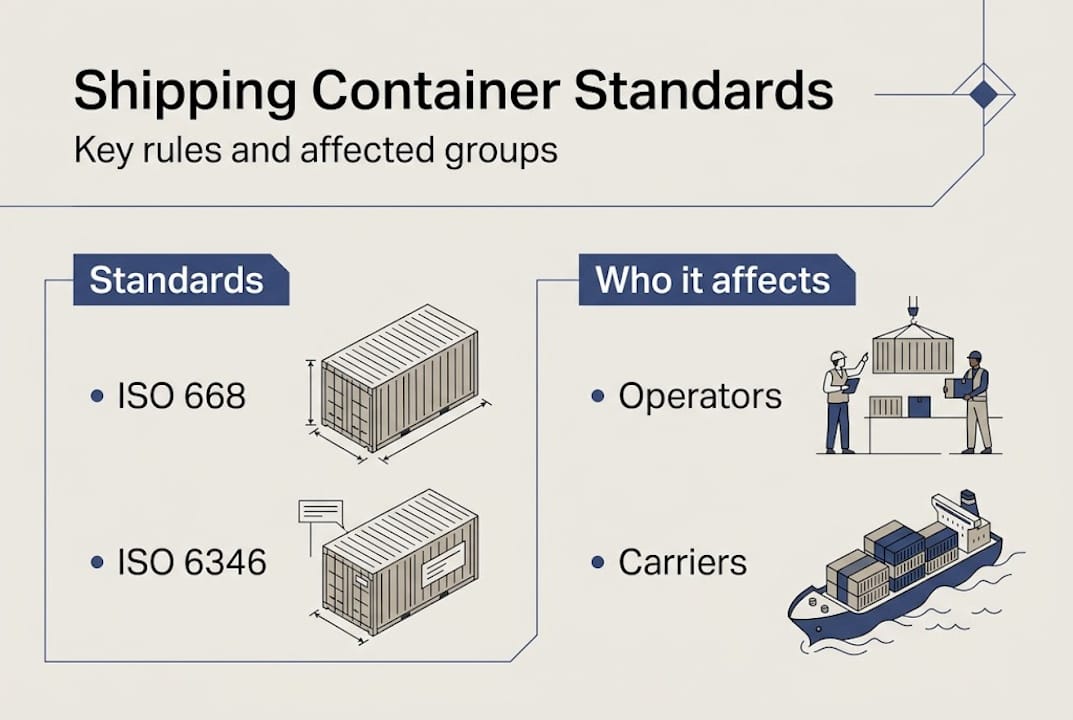
For managers sourcing containers for construction or logistics projects, understanding this framework is non-negotiable. Refer to our container size and dimension guide to see how these standards translate into the specific sizes available in the U.S. market. Containers that do not meet these standards cannot legally be used for international transport and may create liability exposure even in domestic applications.
Key technical requirements: Dimensions, ratings, and coding explained
Knowing the standards exist is one thing. Understanding what they actually require is another. Let's look at the specific numbers and codes that inspectors check.
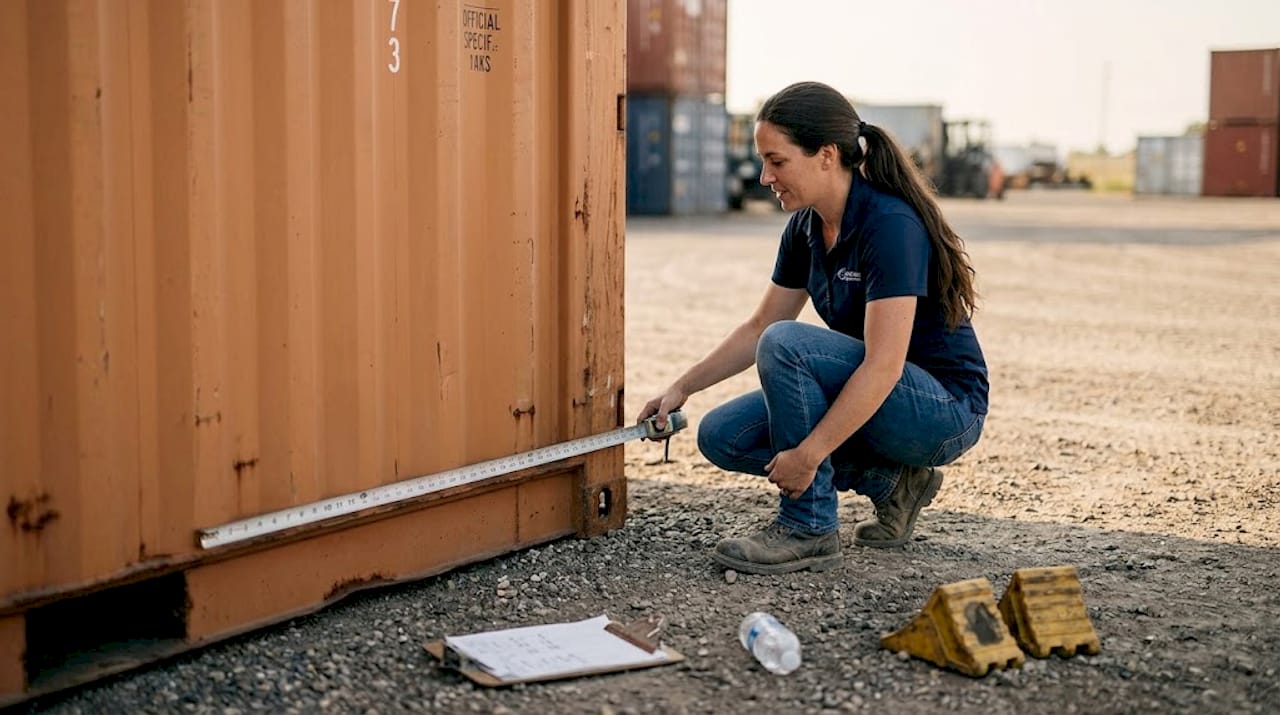
ISO 668 specifies that a standard 20ft container measures approximately 20 feet long, 8 feet wide, and 8 feet 6 inches high, with a maximum gross weight of 30.48 metric tons. A 40ft container shares the same width and standard height, with high cube variants reaching 9 feet 6 inches. These are not suggestions. They are tolerances your containers must meet.
| Container type | External length | External width | Standard height | High cube height | Max gross weight |
|---|---|---|---|---|---|
| 20ft standard | 20ft (6.058m) | 8ft (2.438m) | 8ft 6in (2.591m) | N/A | 30,480 kg |
| 40ft standard | 40ft (12.192m) | 8ft (2.438m) | 8ft 6in (2.591m) | 9ft 6in (2.896m) | 30,480 kg+ |
ISO 6346 marking codes are equally critical. Every compliant container carries a four-letter owner code, a six-digit serial number, and a check digit. It also displays a size and type code that tells handlers exactly what they are working with. Inspectors verify these markings during port checks and audits. Missing or incorrect codes can result in container holds or fines.
Here is a step-by-step checklist for evaluating whether a container meets dimensional and weight standards:
- Confirm external dimensions match ISO 668 tolerances using calibrated measuring tools
- Verify the maximum gross weight rating is visibly marked on the container
- Check that the ISO 6346 owner code, serial number, and check digit are present and legible
- Confirm the size and type code matches the physical container
- Inspect corner fittings for ISO 1161 compliance, including correct aperture dimensions
Pro Tip: Always check for a valid CSC safety approval plate before accepting any container for transport use. The plate shows the date of manufacture, maximum stacking weight, and the date the next inspection is due. If the plate is missing or expired, the container cannot legally be used for international shipping.
For reference, browse our standard 20ft containers and 40ft high cube containers to see how compliant containers are documented and presented.
Testing and inspection: Ensuring compliance and ongoing safety
Compliance is not a one-time event at the factory. It requires ongoing testing and inspection throughout a container's operational life.
ISO 1496 testing covers a full range of structural performance scenarios, including corner lifting, stacking up to nine containers high, racking forces that simulate ship motion, floor loading with forklift pressure, and weather tightness. Each test confirms the container can perform safely under real-world conditions.
Here is how the inspection process works in practice:
- Initial certification: A new container receives a CSC approval plate after passing factory testing
- Periodic examination: Containers must be re-examined at intervals not exceeding 30 months under the CSC Acep (Approved Continuous Examination Program) or at fixed intervals
- Visual inspection: Inspectors check for corrosion, structural deformation, floor damage, and seal integrity
- Documentation review: All inspection records must be retained and available for auditors
- Plate verification: The CSC plate must reflect the most recent examination date and remain legible
"Containers are engineered to withstand stacking nine high and endure 1.8g vertical sea forces. When those structural requirements are compromised through damage or modification, the entire safety system breaks down."
USCG oversees compliance for containers operating in U.S. waters and ports, with authority to detain non-compliant units. Third-party examination bodies accredited under the CSC framework also conduct inspections. You can find details on dry freight container testing and review inspection protocols explained for specialized container types.
Pro Tip: Schedule your next inspection at least 60 days before the due date on the CSC plate. Last-minute scheduling creates delays, and an expired plate can ground your container immediately.
Common compliance pitfalls and how to avoid them
Even experienced managers run into compliance problems. Most failures are predictable and preventable.
The most frequent mistakes include:
- Using non-CSC containers for transport: A container without a valid CSC plate is a storage unit, not a shipping container. Using it for transport violates federal law.
- Stacking modified containers: Cutting openings, adding doors, or altering walls changes the structural load path. Stacking these units as if they were unmodified is a serious safety risk.
- Skipping periodic inspections: Busy operations often push inspections back. Once the CSC plate expires, the container is non-compliant regardless of its physical condition.
- Missing or damaged ISO markings: Containers with unreadable codes get flagged at ports. Repainting or re-marking must follow ISO 6346 exactly.
- Overloading: Exceeding the maximum gross weight is both a safety hazard and a regulatory violation.
Container losses at sea average 1,582 units per year, with crane impacts and improper above-deck stacking among the leading causes. These are not random events. They reflect systematic failures in handling and compliance.
Actionable fixes are straightforward. Verify the CSC plate and ISO markings before every transport use. Train all handlers on weight limits and stacking rules. Document every inspection and keep records in a centralized, accessible system. If a container has been modified, get a structural assessment before using it in a stacked or transport application.
Explore our container solutions and safe uses to see how compliant containers are matched to specific operational requirements.
Industry insights: Why standard compliance still gets overlooked
Here is something most compliance guides will not tell you: the biggest risk is not ignorance of the standards. It is treating compliance as a one-time checkbox rather than an ongoing operational discipline.
Many managers review standards when purchasing containers, then file the paperwork and move on. Months later, a container gets modified for a site office, the CSC plate is never updated, and it gets moved on a flatbed without anyone questioning its status. That is how violations happen. Not through malice, but through routine.
Unmodified ISO containers offer predictable, well-documented performance. The moment you cut into a wall or weld on an addition, you are working outside the tested envelope. That does not mean modifications are wrong. It means they require proper engineering review and updated documentation to remain compliant.
Cost-cutting on inspections is another pattern worth addressing directly. Skipping a $300 inspection to save time often leads to a container being detained at port, costing thousands in delays and re-inspection fees. The math rarely favors the shortcut.
Compliance also has a competitive dimension that gets overlooked. Carriers and insurers check container records. Operations with clean, documented compliance histories get better insurance rates and fewer port delays. Reviewing choosing the right container sizes as part of your procurement process is one practical way to build compliance into the decision from the start, not after the fact.
Get compliant, high-quality containers for your operation
If you're ready to strengthen compliance and safety in your container operations, the right starting point is sourcing containers that already meet ISO and CSC requirements.
A M Shipping Containers offers shipping containers for sale in 10ft, 20ft, and 40ft sizes, all documented with detailed inspection reports and transparent pricing. Every unit is evaluated against industry standards before delivery. Whether you need standard dry freight units or specialized configurations, our team can help you identify the right container for your compliance requirements. Visit our solutions for your needs or browse all available container options to get started.
Frequently asked questions
What are the basic ISO dimensions for shipping containers?
ISO 668 standards define standard containers as 20 or 40 feet long, 8 feet wide, and either 8 feet 6 inches or 9 feet 6 inches high for high cube variants.
Who enforces container compliance in the U.S.?
The USCG enforces compliance under 46 USC Chapter 805, with authority to inspect containers at U.S. ports and detain non-compliant units.
How often do containers need inspection for compliance?
CSC sets mandatory inspection requirements, starting with initial factory certification and followed by periodic re-examinations at intervals not exceeding 30 months under approved continuous examination programs.
What causes most container losses at sea?
Failures in stacking and handling are leading causes, including crane impacts and improper above-deck stacking that exceeds structural tolerances.
Can a modified container be used for shipping?
Modified containers must still meet ISO and CSC structural requirements for transport use; containers that no longer comply after modification are restricted to storage or non-transport applications only.